

Many companies want to do something good for biodiversity and ecosystems, even if they do not directly exert a negative impact on the natural environment. For example, one can do something beneficial for bees. After all, we all know that food production depends on pollinating insects; besides, most people associate bees with something positive, and they also make delicious honey.
Help arrives (that is, the aforementioned simple solution) from the British company Green&Blue. It invented Bee Bricks—bricks with small channels that serve as shelter for solitary bees. A Bee Brick looks like this:
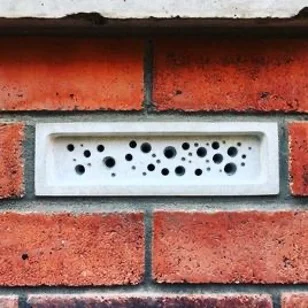
Bee Brick, source: https://www.greenandblue.co.uk/products/bee-brick?variant=23699878674532
It is simply a brick of standard size containing channels of different diameters. Wild bees of various species can nest in them. The Bee Brick only needs to be built into the wall of a building between other bricks. It is completely maintenance‑free, nothing needs to be done with it afterwards. An excellent solution if we want to support local biodiversity, even in a small way!
Excellent, right? Right?
However, the most common species of wild bees for which Bee Brick is designed nest in holes approximately 15 cm deep. These bees lay eggs with females deeper inside the cavity, where they are best protected from predators and parasites, while eggs from which males will hatch are placed closer to the entrance. In natural conditions, a single hole will produce in the next generation several females and a few males. These are the optimal proportions for the survival and development of the species. Meanwhile, the channels in Bee Bricks are only 7 cm deep. They are too shallow. As a result, males begin to dominate the population. Shallower holes also expose the offspring more strongly to threats from the predators and parasites mentioned above.
The bees also need to set up in their new apartment - after all, no one would want to permanently live and raise children in a developer-standard unit without furniture 😉 To use the canals, the bees need mud, clay, sand and fibers of certain plants nearby. Will all this be in the immediate vicinity of the building in which the brick was put?
There is also the question of location. If a Bee Brick is placed at the wrong height (too high or too low) bees will not move in. It should also be installed on a south‑facing or south‑east‑facing wall, in a place that is not shaded. The placement of the bricks therefore needs to be carefully planned already at the stage of designing and constructing the building.
And finally, bees must have something to eat. Bee Bricks can be installed in new developments, yet their surroundings are usually highly manicured. Around new buildings we typically see closely trimmed lawns and perhaps a few shrubs. Bees, however, need diverse plantings of native species that will provide sufficient pollen and nectar.
A study conducted by the University of Exeterfound that two years after installation only about 3% of the channels in Bee Bricks were occupied. Interestingly, in most locations not a single hole was inhabited, while in a few locations (most likely those that were well positioned) many channels were occupied. The study observed 275 bricks (each with 19 holes), whose total cost amounted to approximately PLN 42,000. That is quite a considerable sum to create homes for about 150 bees.
Does this mean that a simple solution like Bee Bricks is bad? But no, it is a brilliant solution. It just needs refinement. And it requires thinking about how to implement it. It requires specialized knowledge, consideration of nuances, analysis of context, good planning. This is the case with most „simple” sustainability solutions. At first glance they seem simple, and in practice it turns out that their effective application requires specialized knowledge. This is not surprising, by the way, because sustainability is the domain of systems thinking 😊.
P.S. So that nobody thinks I aspire to be an expert in bee biology, the inspiration for today’s newsletter came from Apicultural's blog post 😉


 Polish
  English