
The CSRD and ESRS are closely linked. The CSRD Directive specifies which companies are required to report and when this requirement takes effect. The ESRS standards, on the other hand, specify what information must be disclosed and how it should be prepared.
Recently, the regulations governing sustainability reporting have undergone significant changes. These changes affected both the timeline for the implementation of these obligations and the scope of entities subject to reporting, as well as the ESRS standards themselves. The most important changes were related to the package Omnibus I, including the „stop the clock” directive, Directive 2026/470, and work on simplified ESRS.
The most important changes will be discussed later in this article.
The CSRD, or Corporate Sustainability Reporting Directive, is Directive (EU) 2022/2464 of the European Parliament and of the Council of December 14, 2022. It amended several earlier legal acts, including Regulation (EU) No. 537/2014, Directive 2004/109/EC, Directive 2006/43/EC, and Directive 2013/34/EU, with regard to corporate sustainability reporting.
The directive was adopted by the European Parliament and the Council in the fall of 2022, then published in the Official Journal of the European Union, and entered into force twenty days after its publication.
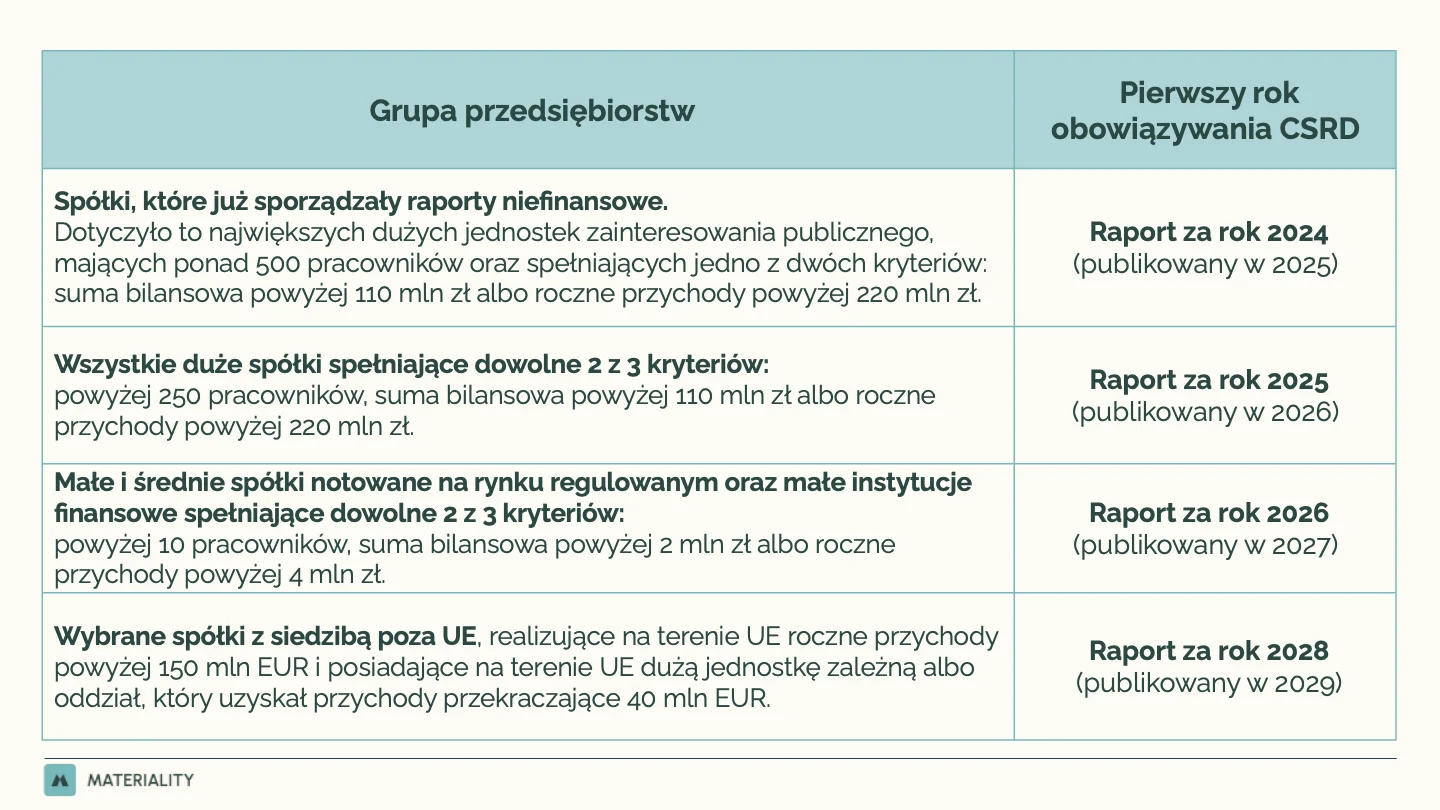
The CSRD has introduced, at the European Union level, a requirement to report information on sustainability in accordance with the uniform European Sustainability Reporting Standards (ESRS). According to the original plan, the reporting requirements were to be phased in for additional groups of companies, starting with reporting for the year 2024.
The current scope of obligations under the CSRD is the result of several stages of legislative changes. The starting point was the original version of the directive, which provided for a broad scope of companies subject to reporting requirements. Subsequently, as part of the package Omnibus I, solutions were proposed that would result in the postponement of some deadlines and a narrowing of the scope of entities subject to mandatory reporting. To understand the current requirements, it is therefore important to review both the original provisions of the directive and the subsequent amendments introduced during the various stages of the legislative process.
In its original version, the CSRD directive provided for a significant expansion of the non-financial reporting obligations previously in force under the IFRS Directive.
The starting point was the recognition that previous regulations did not provide sufficiently comparable, reliable, and complete information on sustainable development, despite the growing demand for such data from investors, financial institutions, business partners, and other stakeholders. The CSRD was therefore intended not only to expand the scope of reporting to include a greater number of entities but also to improve the quality, consistency, and usefulness of the disclosed information through the harmonized ESRS reporting standards.
The original CSRD model called for the phased extension of reporting requirements to successive groups of companies, starting with the largest public-interest entities that had previously been subject to non-financial reporting, through the extension of the requirement to all large companies, both listed and unlisted, and ultimately to include listed small and medium-sized enterprises, as well as certain entities based outside the European Union.
A significant change introduced by the CSRD also concerned the very nature of reporting. It replaced an approach based on more general non-financial disclosures with a model based on uniform European sustainability reporting standards (ESRS). The CSRD and the ESRS standards base reporting on the principle of double materiality, according to which a company should analyze and disclose information from two perspectives. The first concerns the impact of the company’s operations on people and the environment, and the second concerns the impact of sustainability issues on the company itself, its development, performance, financial position, business model, strategy, and risks. This approach was intended to increase the usefulness of reporting for various audiences, including investors, financial institutions, business partners, employees, civil society organizations, and other stakeholders who need both information about risks to the company and information about the impacts of its operations on people and the environment. The CSRD also provided for strengthening the credibility of reporting through the requirement to have sustainability reports attested. The original version of the directive assumed that, initially, the assurance would be at the level of “limited assurance,” and that the assurance level would subsequently be raised to “reasonable assurance.” However, in later stages, the plan to raise the assurance level was abandoned, as discussed below.
On February 26, 2025, the European Commission announced a proposal Omnibus I. Its purpose was to simplify certain provisions related to sustainable development introduced by the original CSRD directive and the first iteration of the ESRS standards.
Changes proposed as part of the package Omnibus I are of significant importance to companies, as they concerned both the effective dates of the reporting obligations and the scope of entities that were originally intended to be subject to reporting under the CSRD.
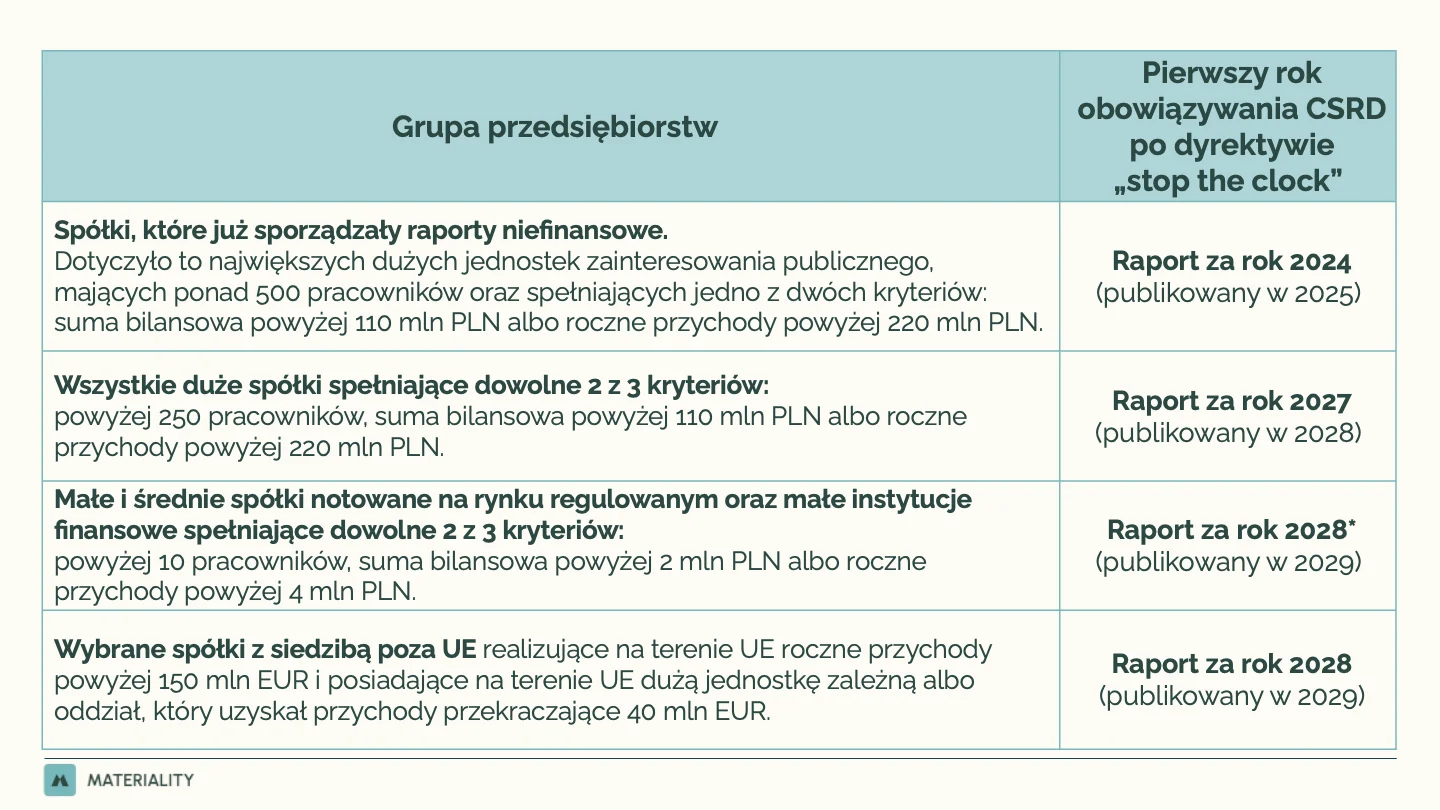
As part of its legislative efforts to simplify sustainable development regulations, the European Commission has begun to signal the need to reduce regulatory burdens and temporarily „pause” the timeline for extending CSRD requirements to specific groups of companies. To this end, even before the final agreement on the changes within the draft Omnibus I, the „stop the clock” directive—that is, Directive (EU) 2025/794—was adopted.
The „stop the clock” directive entered into force on April 17, 2025, and the law implementing it in Poland took effect on August 12, 2025. This measure was intended to allow for smooth work on the Omnibus Package by postponing the application of certain reporting obligations by one or two years.
The next step was to continue working on the package Omnibus I. The amendments to the CSRD were proposed by the European Commission as part of this proposal and were ultimately adopted as Directive (EU) 2026/470. This directive was published in the Official Journal of the European Union on February 26, 2026.
Directive 2026/470 has generally narrowed the scope of entities subject to reporting requirements. It introduced new, higher thresholds and provided for additional exemptions.
These thresholds also apply to corporate groups, with the reporting obligation falling on the parent company.
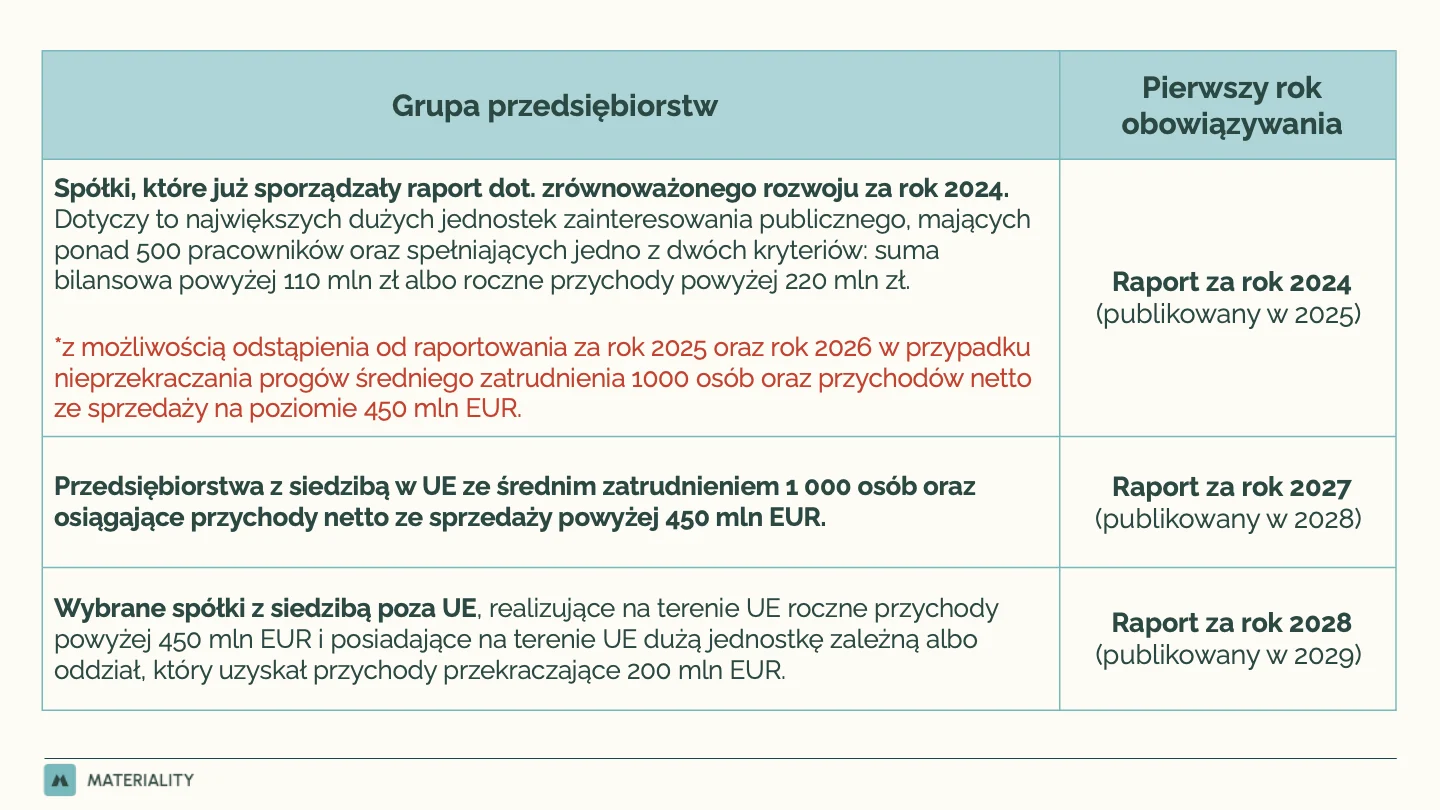
As a result of the changes introduced by Directive 2026/470, the situation varies among different groups of companies.
The amendments to the CSRD have also expanded the exemption for subsidiaries. A company that meets the criteria establishing a reporting obligation but is part of a corporate group whose parent company prepares a report in accordance with ESRS standards may choose not to prepare its own report. Under the previous regulations, publicly traded companies were not eligible for this exemption. Following the changes, this exemption now also applies to publicly traded companies.
In addition to changing the thresholds and timeline, the Omnibus Directive also introduced other changes regarding sustainability reporting. These changes include the discontinuation of sector-specific reporting standards based on the ESRS and the aforementioned discontinuation of reasonable assurance engagements, in favor of limited assurance engagements,
In Poland, the transposition of Directive 2026/470 is planned to take place in two stages.
The draft bill amending the Accounting Act, which is intended to implement these changes, is available on the government's websitethatAbout the Center Legislation listed under item number UC 155 in the work list.
With regard to sanctions, the Omnibus Directive does not introduce any direct changes to the system of criminal sanctions in Poland. Under current regulations, failure to prepare or certify a sustainability report may result in a fine or a restriction of liberty for the person responsible for its preparation.
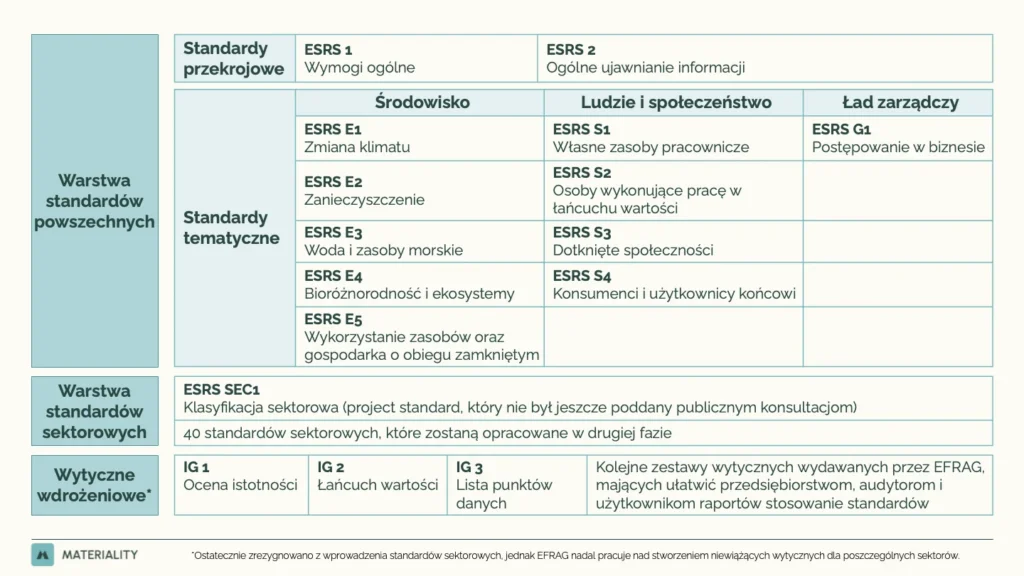
Reports prepared in accordance with the CSRD are drafted in accordance with the European Sustainability Reporting Standards (ESRS).
EFRAG, the European Financial Reporting Advisory Group, prepares draft standards for the European Commission. A special working group established within EFRAG—the PTF ESRS, or Project Task Force on European Sustainability Reporting Standards—is responsible for developing the draft.
This team consisted of Piotr Biernacki, Sustainability Managing Partner at MATERIALITY. He served as co-lead of the subteam that developed draft cross-cutting standards and sets of guidelines. Information about his participation is available here: Piotr Biernacki at EFRAG.
The first ESRS standards were issued by the European Commission in the form of delegated acts. Work is currently underway on simplified ESRS standards. The draft simplified ESRS was publicly announced on December 4, 2025, by EFRAG, and then published by the European Commission as a draft delegated act and subjected to a public consultation that ran from May 6 to June 3, 2026. On the third In July 2026, the European Commission adopted the revised, simplified ESRS and a voluntary reporting standard for smaller companies outside the scope of the CSRD. However, the Commission’s adoption does not mark the end of the entire procedure, as the delegated acts have been submitted to the European Parliament and the Council for review as part of the so-called. scrutiny period.
On July 31, 2023, the European Commission issued a delegated regulation introducing the first set of ESRS standards. Commission Delegated Regulation (EU) 2023/2772 was published in the Official Journal of the European Union on December 22, 2023.
Delegated Regulation 2023/2772 entered into force and has been applicable since January 1, 2024.
The European system of sustainability reporting standards is based on the ESRS, which define the scope of disclosures required from companies subject to the CSRD.
The changes affected not only the CSRD but also the ESRS standards. On July 11, 2025, the European Commission adopted Delegated Regulation 2025/1416, referred to as the „Quick Fix.” This regulation introduced changes to the first set of ESRS standards.
The goal of „Quick Fix” was to reduce the administrative burden on entities that are already subject to reporting requirements for 2024.
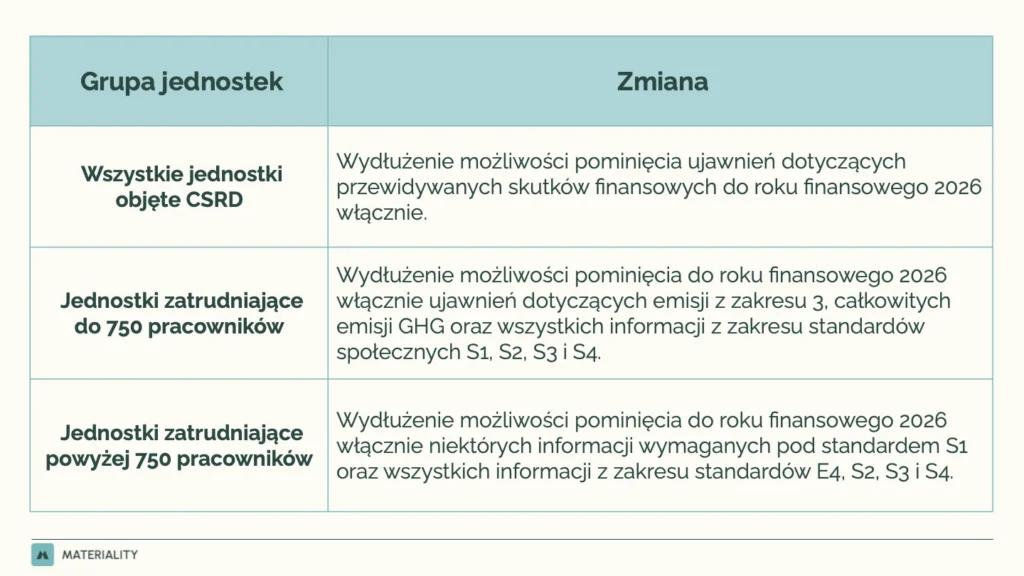
As part of the Omnibus project, the European Commission commissioned EFRAG to prepare draft simplified ESRS standards. EFRAG published the draft simplified ESRS, after which the European Commission presented its own draft delegated act and conducted a public consultation. On July 3, 2026, the European Commission adopted the revised ESRS standards and a voluntary reporting standard for smaller companies.
The revised ESRS are intended to reduce the administrative burden while maintaining the quality of disclosures. According to the Commission’s press release of July 3, 2026, the standards are shorter and more transparent, introduce additional flexibility, and simplify key processes. The Commission also noted that the number of mandatory data points has been reduced by more than 60%, and the total number of data points by more than 70%.
From a formal standpoint, the delegated acts adopted by the Commission will be submitted to the European Parliament and the Council for review. The revised ESRS will not enter into force until this stage is completed without any objections being raised. The standard scrutiny period lasts two months and may be extended by an additional two months.
In this context, the “scrutiny period” refers to the period during which the European Parliament and the Council review a delegated act. During this time, both institutions may examine the act adopted by the Commission and raise objections. If no objection is raised within the prescribed time limit, the delegated act may enter into force. This means that the mere adoption of the simplified ESRS by the Commission on July 3, 2026, does not yet mean that they have entered into force.
Under the adopted regulation, the revised ESRS may be applied on a voluntary basis as early as for financial statements for the 2026 fiscal year. However, their application will become mandatory starting with the 2027 fiscal year—that is, for reports covering 2027 published in 2028. In practice, this means that entities reporting for 2026 may choose to adopt the new standards early, but the primary obligation to apply the revised ESRS will begin with reporting for 2027.
Changes to the CSRD and ESRS mean that companies’ reporting obligations may differ from what was originally envisaged in the directive. Some companies have been granted an extension of the deadlines, some may be exempt from mandatory reporting due to the new thresholds, and some will continue to report if they meet the new criteria.
From the perspective of businesses, it is therefore crucial to regularly verify whether they are subject to the reporting requirement, from which year such a requirement may apply, and whether it is possible to take advantage of the exemptions provided for in the regulations. It also remains important to monitor further developments regarding the ESRS, particularly with regard to simplified standards and the practical guidelines for their application.
Regardless of any lack of a reporting obligation, companies may consider voluntarily disclosing information related to sustainability. Such actions can support communication with investors, financial institutions, customers, contractors, and other business partners, especially where market expectations or supply chain requirements go beyond formal legal obligations.
We will guide your company through the entire sustainability reporting process. Learn more about our service and schedule a consultation.
Share

 Polish Polish
  English Polish Polish English

