

You can find the report summarising the survey conducted by GlobeScan, ERM Sustainability Institute and Volans here. It drew on 610 sustainability professionals from around the world. As last year, a majority (59%) remain convinced that the way we manage sustainability should change radically. A further 36% of experts believe the approach is broadly right but needs some changes.
The most interesting part, however, is how respondents assessed 65 levers of change, i.e. various types of action that contribute to the sustainable transition. For each of them, they rated two things: impact (whether the lever will bring significant positive change over the next five years) and feasibility (whether it can be implemented at scale within that time).
Below is a rather complex visualisation (after all, there are as many as 65 levers) of the results of the two most recent surveys, from 2025 and 2026.
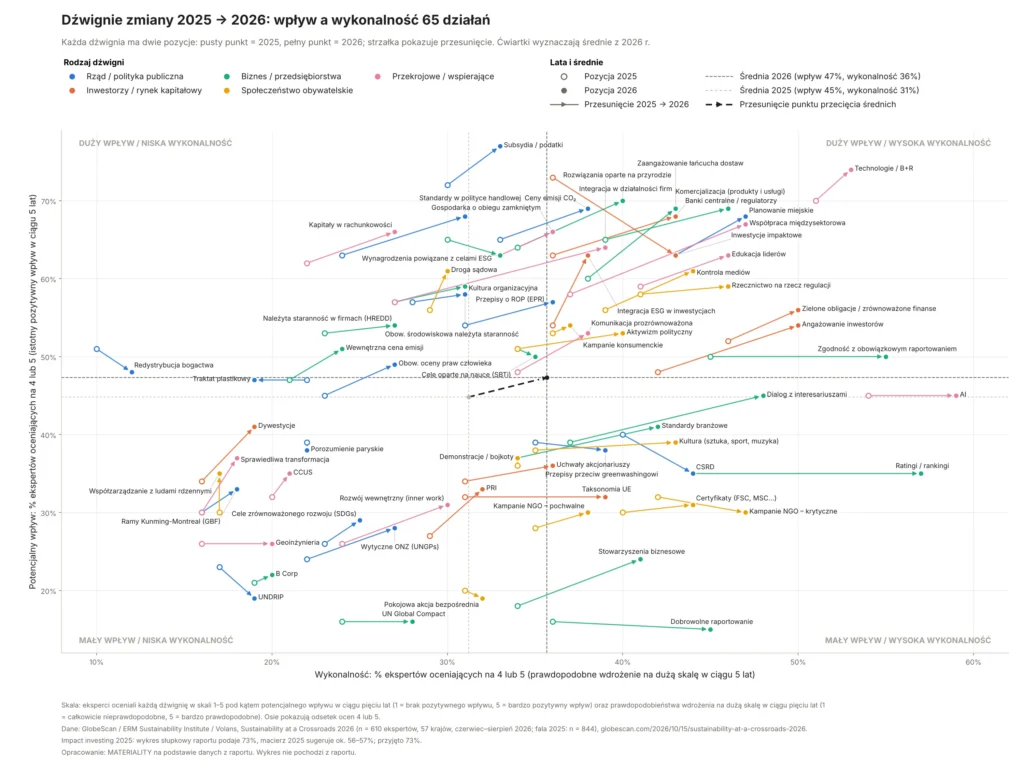
What can we read from this chart? First of all, most of the arrows point to the right. This means that respondents believe change can be implemented to a greater extent than they thought a year ago. Some arrows also point upwards, meaning that the impact of particular actions is rated higher, although there are also arrows pointing downwards (lower impact).
If you look closely at the names of the individual points, you will see that the bottom-left quadrant (levers with low impact and low feasibility) contains many voluntary actions. The top-right quadrant, by contrast, holds most of the “hard” levers, relating to technology, legal frameworks, finance and the functioning of markets.
This very split underpins the green paper in which John Elkington foresees a shift from soft to hard sustainability.. “Soft” sustainability means change that is voluntary, incremental and delivered company by company. “Hard” sustainability means change that is binding, systemic and focused on redesigning entire markets. The point is not, of course, that one approach is bad and the other good. The change under way is a transition from one era to the next.
I encourage you to read both the report and the green paper itself. However, if you are looking in it for answers to questions such as “So what should I, an ESG specialist at company X, do now?”, “What should I take to the board?” or “What skills do I need to take an active part in this change over the coming decade?”, you will not find them. And that is my main reservation about this document. I agree with its theses and with the conclusions it presents. I do think, though, that it stops too early, at the stage of meta-analysis, and does not offer practical answers to the age-old question “What is to be done?”. I nonetheless plan to take part in the consultation, and I hope that the white paper announced for December will go that one step further.
An exceptionally interesting and turbulent decade lies ahead in the world of sustainability. It would be worth having a guide that maps out at least some of the paths we could follow 😊


 Polish
 English